

Ask any group of serious whitetail hunters when the biggest bucks get killed during the rut, and you will hear the same answer: the middle of the day. Mature bucks cruise between bedding areas from late morning through early afternoon while most hunters are back at the truck eating a sandwich. The all-day sit is one of the most effective tactics in deer hunting, and the thing that breaks it is rarely patience or cold. It is food. A hunter who did not pack right gets hungry, gets miserable, and climbs down at 10:30. This article is about making sure that hunter is not you.
Why Food Planning Is a Hunting Tactic
Sitting still in cold weather burns far more energy than most people expect. Your body is running its furnace all day, and shivering alone can double your calorie burn. An underfed hunter gets cold faster, fidgets more, loses focus, and starts negotiating with himself about leaving. A fed hunter stays warm, stays still, and stays sharp for the ten seconds of the day that actually matter.
Plan on 2,500 to 3,500 calories for a dark-to-dark sit in cold weather, which is roughly double a normal day of food. That sounds like a lot until you remember you are essentially winter camping in a tree for twelve hours. Pack it in small portions you can eat every hour or two rather than one big lunch, because a steady drip of fuel keeps your core temperature more stable than a single meal, and it avoids the post-lunch slump that has put plenty of hunters to sleep in the stand.
The Three Rules of Treestand Food
It has to be quiet. A crinkling mylar wrapper at 20 feet sounds like a freight train in a silent November woods. Repackage everything at home into soft zip-top bags, unwrap granola bars ahead of time, and skip anything in crackly foil or hard plastic. This one habit does more for your all-day sit than any product you can buy.
It has to be low-odor. You do not need to eat like a scent-control robot, but leave the tuna, the summer sausage with garlic, and anything vinegar-heavy at home. Mild, dry foods carry less odor, and everything should ride inside a sealed bag in your pack, both for scent and to keep mice out of your gear on the ground blind floor.
It has to work without cooking. No flames, no crinkly freeze-dried pouches, no assembly. If it cannot be eaten one-handed with your eyes still on the shooting lanes, it does not make the pack.
What Goes in the Pack
Jerky: The Standard for a Reason
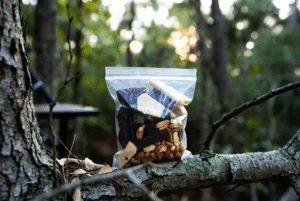
Jerky has been the hunter’s snack for generations because it solves every treestand problem at once. It is silent to eat, packed with protein that keeps you full for hours, nearly odorless compared to most meats, and immune to freezing, crushing, and being forgotten in a pack pocket until next season. A few ounces spread across the day is the backbone of a good stand menu. Many of us make our own from last year’s venison, which is its own reward, but stocking up before the season is easier than ever, and online retailers like Jerky Brands carry enough styles and flavors in one place to keep your pack interesting from October through late season.

The Supporting Cast
Around the jerky, build a rotation: mixed nuts or trail mix repacked in soft bags, peanut butter crackers made at home the night before, dried fruit for quick sugar on the coldest hours, a couple of soft granola bars (pre-unwrapped), cheese sticks in cold weather when they keep all day, and a bagel with peanut butter that survives a pack far better than bread. Hard candy earns its spot too: a butterscotch or peppermint kills an hour of boredom silently and keeps your mouth from getting dry when you are breathing cold air.
The Thermos Is Worth Its Weight
Nothing resets a shivering hunter like something hot at noon. A quality vacuum bottle of coffee, hot chocolate, or broth is worth every ounce it costs you on the walk in. Broth in particular is underrated: it is warm, salty, and settles a cold stomach better than sweet drinks. Test your thermos at home first, because the difference between a good one and a cheap one at 2 p.m. in December is the difference between hot soup and sad, lukewarm disappointment.
Water: The Mistake Everyone Makes
Cold-weather hunters chronically under-drink because they do not feel thirsty, and mild dehydration makes you colder, more tired, and more impatient. Bring more water than feels necessary, at least two liters, and sip steadily instead of chugging. In freezing temperatures, store bottles upside down in your pack (ice forms at the top, which is the bottom when flipped) or keep one inside your outer layer. Yes, drinking more means managing nature’s call, but that is what a dedicated bottle is for, and every all-day hunter figures that system out fast.
Timing Your Eating Around Deer Movement
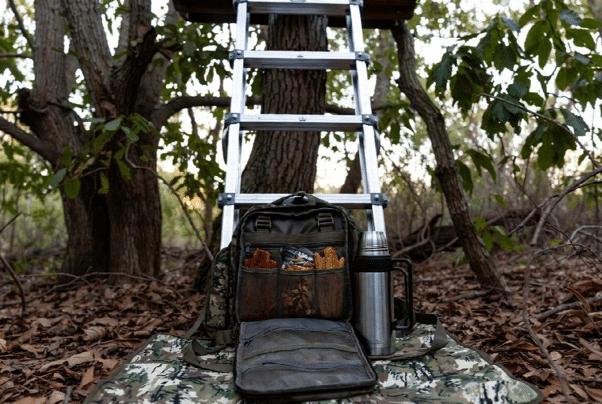
Eat during lulls, not during prime windows. The first two hours of light and the last two belong to your eyes and ears, not your snacks. Save the bigger eating for the 10 a.m. to 2 p.m. stretch, but stay alert while you chew: during the rut, that midday window is exactly when a cruising buck appears from nowhere. Keep every snack reachable without standing up or unzipping anything loud, ideally in a chest pocket or a pack hung at shoulder height. The number of deer that have caught hunters elbow-deep in a backpack is beyond counting.
A Simple All-Day Sit Food List
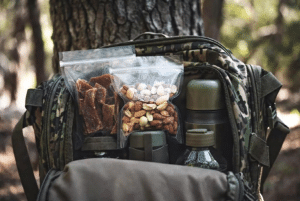
For one hunter, dark to dark: 4 to 6 ounces of jerky, one bag of trail mix or nuts, one bagel with peanut butter, two soft granola bars, dried fruit, a few hard candies, cheese sticks in cold weather, a full thermos of something hot, and two liters of water. Repackage all of it into quiet bags the night before, stage it in your pack by when you plan to eat it, and you are set for twelve hours without a single crinkle.
The all-day sit is a mental game, and food is half the mental game. Pack enough calories, pack them quiet, and the decision to stay until dark stops being a battle of willpower. Stay in the tree. The midday buck is counting on you being back at the truck.